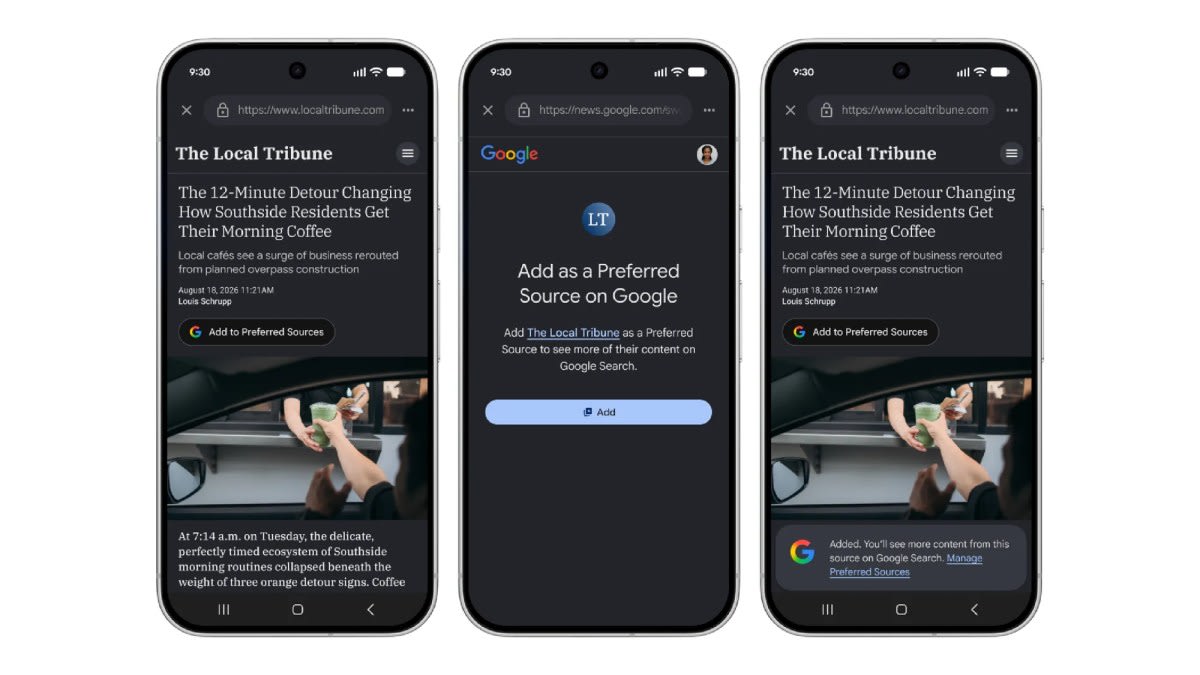
The digital landscape is undergoing a structural shift that keeps digital marketers and business leaders awake at night. As Generative Search Experience (GSE) and AI-powered query responses become the default, the traditional funnel—where users search, click, and visit a website—is thinning. For content publishers and businesses that rely on organic traffic for customer acquisition, the erosion of the "click" represents a fundamental challenge to Digital Transformation ROI.
Google has recently responded to this growing friction with a new feature that allows users to designate preferred publishers. By marking a source as a "preferred" destination, users signal to Google’s algorithms that they want content from that specific entity to take precedence across Google Search, Discover, and Google News. While this may appear to be a simple UI update, it represents a profound evolution in how search engines view authority in an age of synthetic content.
The Shift from Discovery to Intent-Based Loyalty
For years, the gold standard of SEO was capturing high-intent keywords to drive volume. However, as Large Language Models (LLMs) begin to answer queries directly within the SERP (Search Engine Results Page), the incentive for a user to leave the search environment is diminishing. We are moving toward an era where the platform itself becomes the destination.
By allowing users to curate their own "preferred sources," Google is effectively offloading the burden of quality control to the consumer. This creates a new competitive tier for businesses. When a user explicitly flags a brand as a preferred source, they are opting out of the generic, AI-synthesized answer in favor of a specific brand voice. For businesses, this means that your Brand Equity—your reputation, your tone, and your domain authority—is becoming your most critical defensive moat.
This feature introduces a new set of dynamics for digital strategy:
- Algorithmic Preference: Brands with high engagement metrics are more likely to be suggested as "preferred" sources, creating a flywheel effect where success breeds visibility.
- Reduced Friction in Customer Journeys: By staying present in the user’s Discover feed, companies can nurture long-term leads without relying solely on the volatile nature of keyword ranking.
- The Rise of Owned Audience: This move mirrors the shift toward newsletter-first models, where businesses prioritize direct lines of communication over relying on the "hired" traffic of third-party search engines.
ROI Implications and the Future of Traffic
For leaders overseeing content marketing and digital growth, this is not just a UI tweak; it is a resource allocation signal. The ROI of high-quality, long-form content has been under pressure as AI summaries frequently cannibalize the initial paragraphs of articles. By prioritizing brand loyalty, businesses can mitigate some of the "zero-click" impact.
However, capturing this preference requires a recalibration of the customer experience. Users will not "star" a brand that offers thin or generic content. To capitalize on this feature, companies must shift from purely transactional SEO tactics toward Thought Leadership and proprietary data reporting—content that AI models struggle to synthesize without referencing the original source.
Furthermore, this development highlights the necessity of integrating content strategy with broader automation ecosystems. If a user is pushed to your site through a preferred source status, your digital infrastructure must be ready to capture that engagement. Modern CRM systems and AI Agents now play a pivotal role in this interaction. Once the user clicks, the business has a fleeting window to convert that visitor into a repeat customer or an email subscriber. Relying on manual processes to guide that user is no longer sufficient; the journey must be seamless, personalized, and automated the moment they land on the page.
Integrating Authority into the Automated Ecosystem
As search engines lean into these personalized feedback loops, the gap between businesses that proactively manage their digital presence and those that remain reactive will widen. The key takeaway for business leaders is that search is no longer a passive utility; it is a collaborative platform.
To navigate this transition, organizations must move away from viewing search engines as monolithic traffic sources. Instead, they should treat them as partners in a broader digital ecosystem where brand affinity is the currency of choice.
Adoption of these new features should be integrated into your existing growth stack. If your team is struggling to manage the influx of data or the complexities of aligning your content strategy with these new algorithmic behaviors, leveraging specialized support is essential. At AOODAX, we help businesses bridge the gap between their content strategy and technical execution by deploying custom AI agents that manage and nurture incoming traffic, ensuring that every visitor captured through search is immediately integrated into a personalized, high-conversion customer journey.