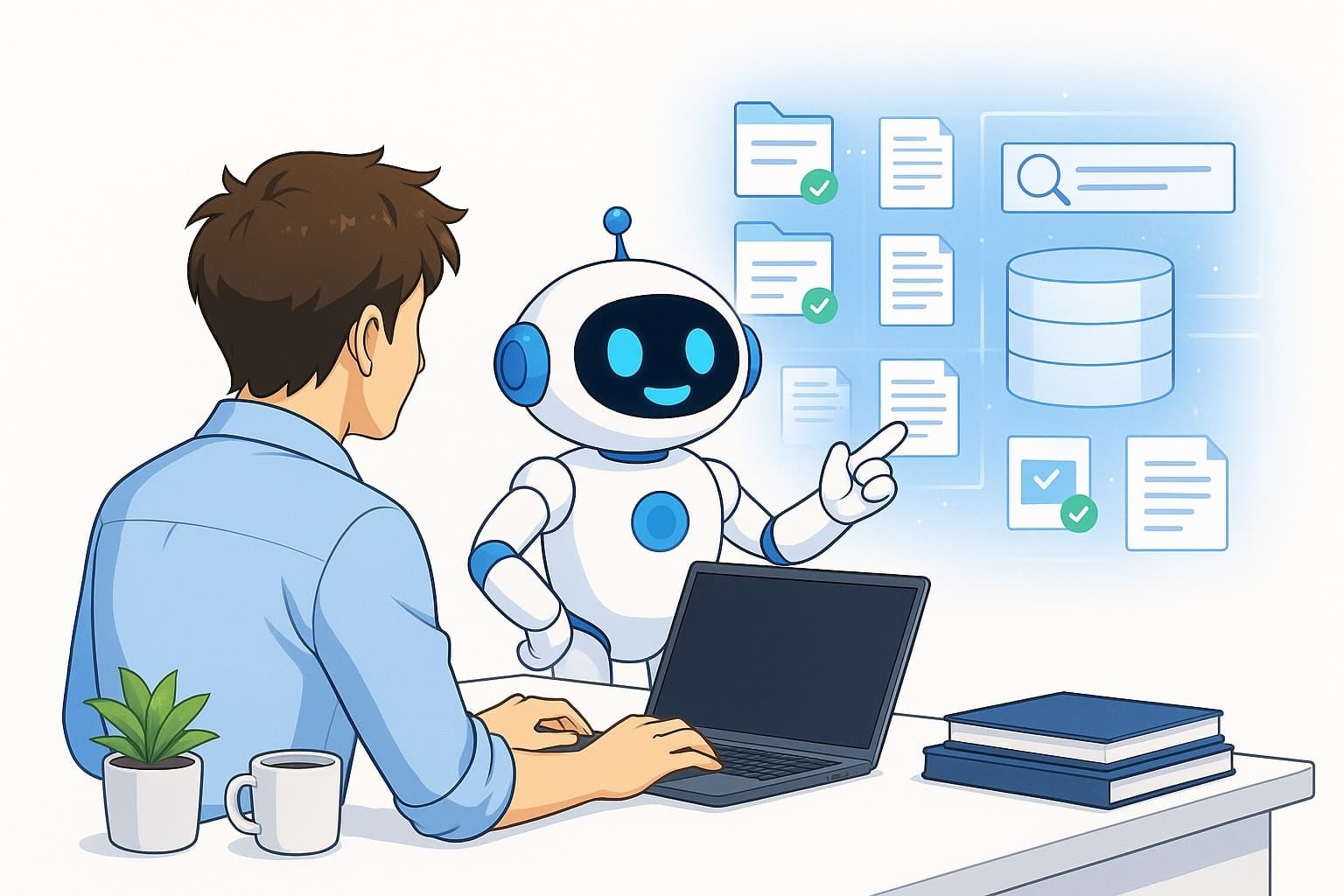
The era of the "static" knowledge base is effectively over. For years, enterprises have relied on traditional, keyword-driven search mechanisms—wikis, convoluted internal PDFs, and fragmented SharePoint folders—that functioned more as digital graveyards than actual repositories of intelligence. Today, the convergence of Large Language Models (LLMs) and autonomous AI agents is transforming these stagnant silos into dynamic, reasoning-capable engines that don't just store information, but actively participate in corporate decision-making.
For business leaders, the transition from simple document retrieval to agentic knowledge orchestration represents one of the most significant ROI drivers in the current digital transformation landscape. It is the shift from searching for an answer to having the answer synthesized and applied to a business process in real-time.
The Architecture of Agentic Intelligence
Building a modern knowledge base is no longer about better tagging or more robust database schema; it is about architecture. The new standard requires a multi-layered approach where data is ingested, indexed, and made accessible to AI agents that possess the "reasoning" capability to navigate complex internal contexts.
When we talk about "agentic" knowledge bases, we are referring to a framework that moves beyond basic Retrieval-Augmented Generation (RAG). While RAG is essential for grounding LLMs in company-specific data, the next leap involves coding agents—specialized automation scripts that act as the intermediaries between your unstructured data and the LLM’s reasoning engine. These agents can dynamically fetch data from your CRM, cross-reference it with technical documentation, and verify the accuracy of the information before presenting it to an end user.
To build an architecture that provides tangible business value, leaders should prioritize the following components:
- Semantic Data Processing: Move away from keyword matching. By utilizing vector embeddings, your system can understand the intent behind a query rather than just the literal words, allowing agents to surface relevant insights even when the terminology differs.
- Dynamic Context Injection: Instead of passing an entire document to an LLM—which is costly and inefficient—use intelligent indexing to provide only the relevant "chunks" of information that the agent needs to complete a specific task.
- Agentic Verification Loops: Implement "critique" agents that review the output of the LLM against your internal knowledge base to ensure the information is up-to-date and compliant with company policy, significantly reducing the risk of hallucinations.
- Cross-Functional Connectivity: Ensure that your knowledge base is not siloed. By integrating it with your primary ERP (Enterprise Resource Planning) and CRM platforms, agents can contextualize knowledge with real-time operational data.
Operational Impact and ROI Metrics
The adoption of agentic knowledge management is fundamentally changing the economics of internal productivity. In traditional settings, the "time to knowledge"—the interval between a question being asked and a correct, actionable answer being received—is often measured in minutes or hours, if not days of back-and-forth emails. An agent-driven system reduces this to seconds.
For organizations, the ROI of this shift manifests in several key areas:
- Drastic Reduction in Technical Debt: By automating the curation of documentation, you eliminate the overhead of manually updating wikis and manuals. Agents can "read" code repositories or system logs to identify outdated processes and suggest updates.
- Increased Customer Experience (CX) Velocity: When your support staff (or front-facing chatbots) can access an agentic knowledge base, they are no longer restricted to scripted responses. They can provide bespoke solutions to complex customer issues by querying the organization’s entire intelligence history.
- Scalable Onboarding: Rapidly integrating new talent is a chronic pain point. AI agents can serve as personalized mentors, navigating new hires through internal protocols and project histories far more effectively than traditional HR documentation.
- Operational Resilience: As organizations move toward decentralized, remote-first work, knowledge retention becomes a critical risk. An agent-based system ensures that the "tribal knowledge" residing in the heads of long-tenured employees is captured, digitized, and made accessible to the entire company.
The Path Forward: Integration Over Innovation
Adoption trends indicate that the companies succeeding in this space are not the ones spending millions on custom, proprietary LLM development. Instead, they are the ones investing in the integration layer. The objective is to create a seamless fabric that ties existing data pipelines to intelligent agents. This is an evolution of digital transformation, where the focus shifts from merely moving processes online to making those processes self-optimizing.
The challenge for leadership is identifying which workflows offer the highest utility for agentic integration. Start with high-frequency, document-heavy workflows—such as compliance reviews, technical support troubleshooting, or sales enablement—where the cost of error is managed by human-in-the-loop validation, but the speed of information retrieval is the primary bottleneck.
Looking ahead, we are moving toward a future of "autonomous operations." As these systems mature, we will see knowledge bases that don't just sit and wait for questions, but proactively push insights to stakeholders before they even realize a gap exists. The competitive advantage will go to those who treat their institutional knowledge as a live, programmable asset rather than a static library.
At AOODAX, we focus on helping enterprises design and deploy the intelligent infrastructure required for this transition. By leveraging custom AI agents, we enable businesses to turn their internal data into a powerful, automated engine that enhances decision-making and operational efficiency across the entire organization.