In the fast-paced evolution of digital product development, the "fragmentation of experience" has become a silent killer of ROI. For business leaders, this manifests as design debt—a gradual accumulation of inconsistent UI components, misaligned branding, and erratic user journeys that arise when product teams scale rapidly without a central source of truth. As we navigate the era of AI Agents, the challenge is no longer just about writing code; it is about maintaining a coherent, high-velocity design language across sprawling digital ecosystems.
The emergence of tools like Claude Code—a CLI-based agent capable of understanding, interacting with, and modifying codebases—signals a paradigm shift in how we manage technical and design consistency. Rather than treating design as a static asset governed by a PDF brand guideline, we are moving toward an era of "living design systems" where AI serves as the gatekeeper of visual integrity.
Scaling Design Through Intelligent Automation
Traditional approaches to maintaining design consistency often rely on manual oversight, rigid design systems, and lengthy PR (Pull Request) reviews. This model breaks down as organizations implement Digital Transformation strategies that require integrating multiple legacy platforms with modern frontend frameworks. When teams move fast, styling discrepancies creep in: a button color that is slightly off-brand here, a padding mismatch there, or a button interaction that defies the global UX pattern.
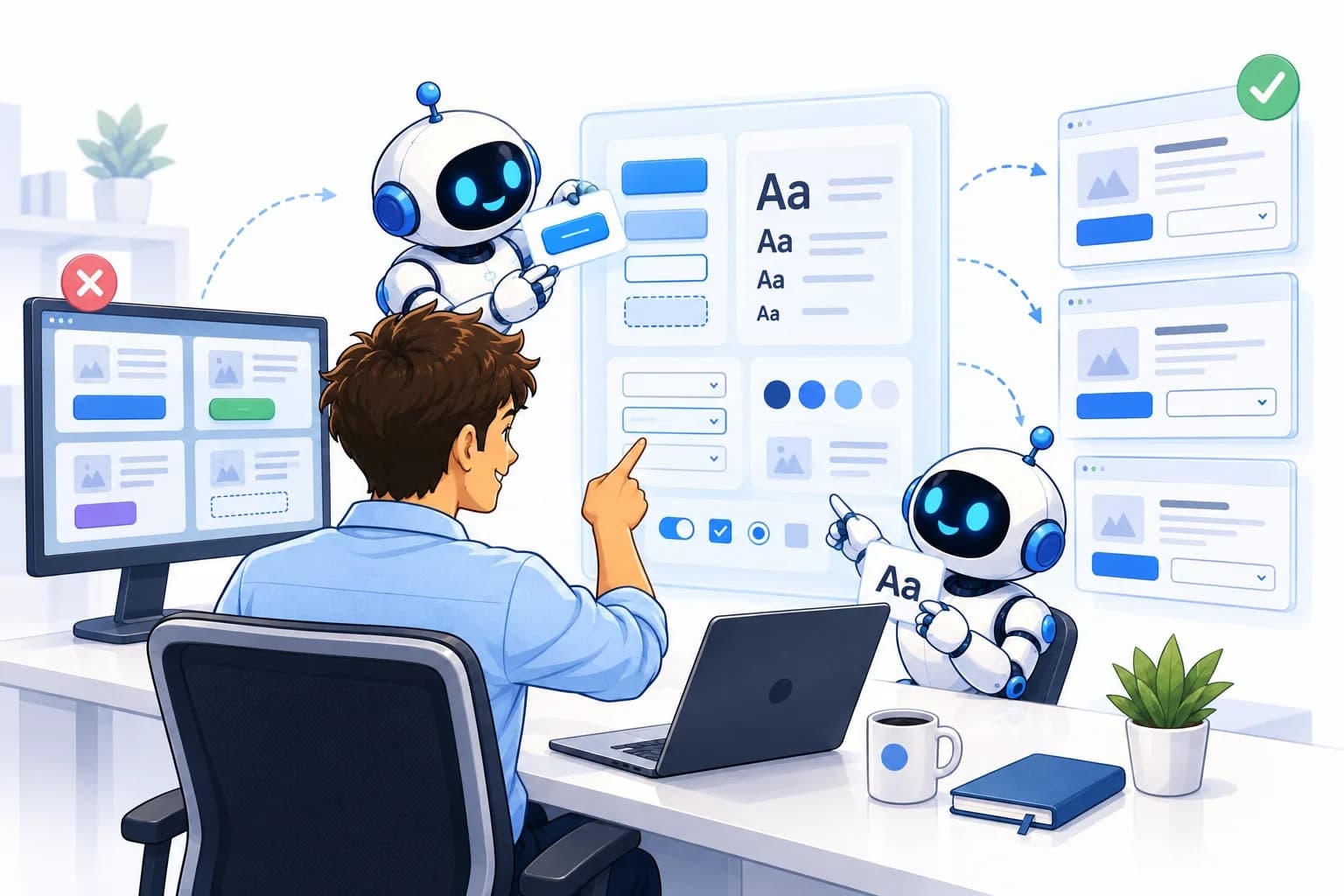
By leveraging an agentic workflow, teams can now inject design guardrails directly into the development loop. Modern AI-assisted development tools enable developers to:
- Enforce Component Library Usage: AI agents can scan local codebases to identify if a developer is creating custom CSS rather than utilizing the established component library, prompting an automatic correction.
- Maintain Semantic Consistency: Agents can analyze context to ensure that UI labels, error messages, and interactions adhere to the established tone-of-voice and naming conventions defined in the company’s design tokens.
- Refactor Legacy UI at Scale: Instead of manually updating hundreds of files, agents can be instructed to migrate deprecated legacy components to a modern, standardized library, ensuring that the entire interface reflects the current brand identity.
This shift isn't just about aesthetics; it is a business imperative. A unified user interface significantly reduces the cognitive load for customers using your CRM or customer portal. When a digital product feels cohesive, trust increases, and the friction associated with learning new features decreases, directly impacting customer retention and satisfaction metrics.
The ROI of Agentic Design Governance
For the C-suite, the adoption of AI-led development workflows is fundamentally a play for operational efficiency. When developers spend less time fixing "design bugs" and more time building core business logic, the velocity of product delivery increases. Furthermore, by automating the enforcement of design systems, businesses minimize the need for endless rounds of visual QA, which often bottleneck deployment cycles.
The adoption trends in the software industry indicate a clear move away from purely human-governed design systems toward hybrid models. In these models, human designers focus on high-level strategy and system creation, while AI agents handle the "janitorial" work of implementation—ensuring that every line of code emitted adheres to the established design language.
Consider the implications for Custom Software development. If a company is building an internal dashboard to connect disparate data streams, the cost of inconsistency can be high. Disjointed UI elements lead to human error in data entry or interpretation. By training or prompting AI agents with the specific design system tokens and pattern libraries of an organization, companies can ensure that every new feature added to their internal tools is native, intuitive, and perfectly aligned with the broader digital ecosystem.
The strategic advantage here lies in "design-as-code." By treating design tokens as the primary interface through which AI agents interact with the codebase, companies ensure that the machine learning models assisting their developers are effectively "thinking" in the company's brand voice.
Future-Proofing the User Experience
As we look toward the next three to five years, the role of developers will continue to shift toward "architecting by intent." The actual implementation of UI—the pixel-pushing, the responsive adjustments, the theme switching—will increasingly be automated. This does not devalue the human role; rather, it elevates it to the level of systems architecture. Business leaders should begin viewing their design systems not just as documentation, but as executable code that informs their AI stack.
To succeed in this environment, leadership must prioritize the following:
- Centralize Design Tokens: Ensure all design elements (spacing, colors, typography) are codified into accessible JSON or CSS variables that AI can ingest.
- Invest in Agentic Tooling: Audit current development environments to identify where AI agents can be integrated to automate standard linting and component enforcement.
- Bridge the Gap Between Design and Dev: Use AI to translate design-level changes directly into the codebase, creating a seamless loop between a designer’s Figma updates and the actual production environment.
The businesses that win will be those that view AI not as a shortcut, but as a force multiplier for quality and consistency. By integrating these agents into your development lifecycle, you ensure that your digital products evolve without losing the core identity that defines your brand.
At AOODAX, we understand that maintaining this level of consistency requires more than just the right tools; it requires a sophisticated integration strategy. Our team specializes in implementing custom AI agents that can seamlessly align with your existing development workflows, ensuring your digital products stay consistent and scalable.