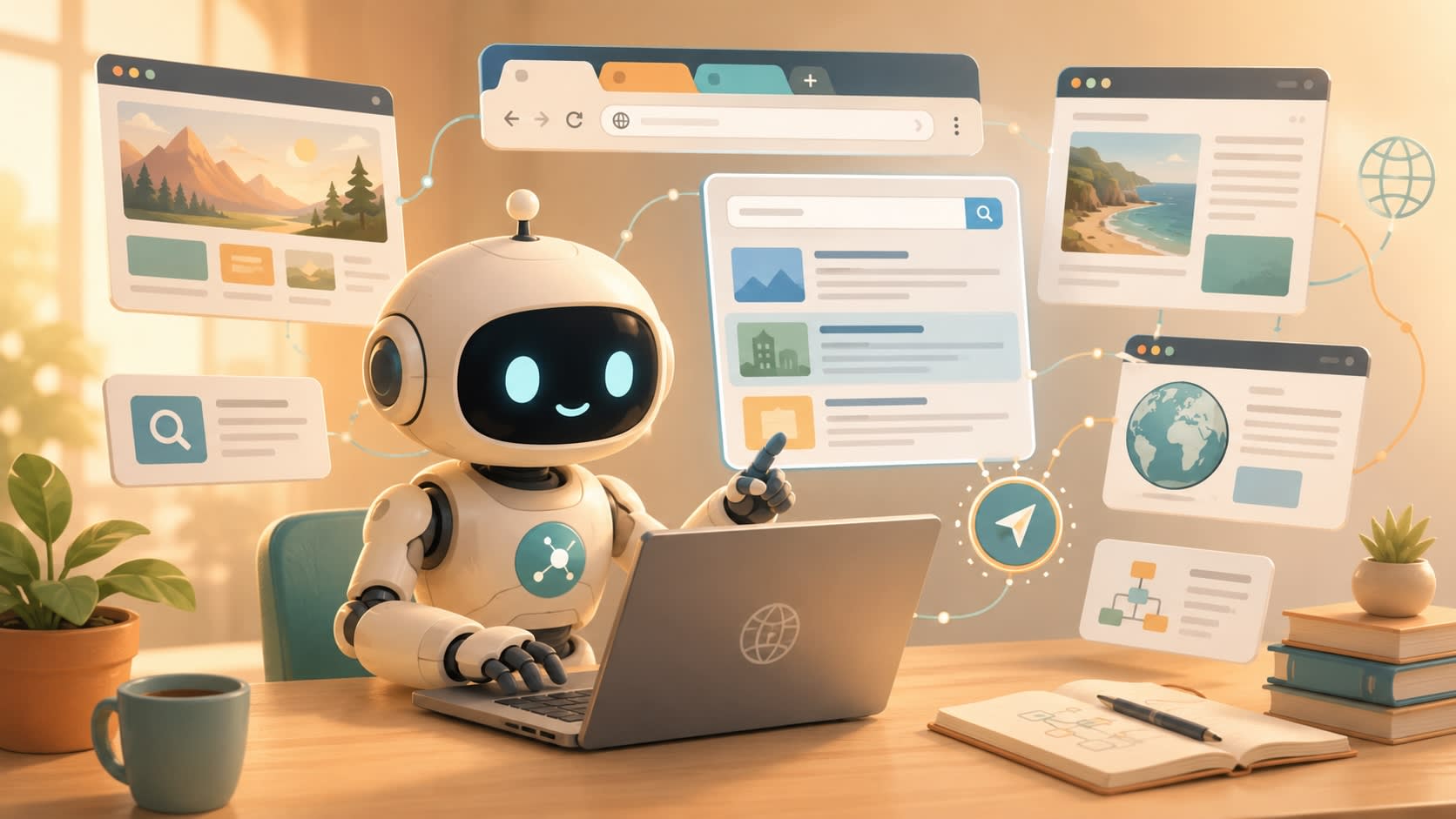
For years, the promise of automation has been anchored in the rigid, API-driven world. If a software platform didn’t offer a public API, your automation strategy hit a brick wall. Today, that paradigm is shifting rapidly. We are moving away from fragile "screen scraping" and toward a new era of Autonomous Browser Agents—software entities capable of interpreting visual interfaces, clicking buttons, and navigating complex web workflows just like a human analyst.
By integrating Large Language Models (LLM) with robust browser automation frameworks like Playwright and the Model Context Protocol (MCP), businesses can now extend the reach of their AI workforce to virtually any cloud application. This transition represents a fundamental leap in digital transformation, moving us from passive data processing to active, interface-based execution.
The Convergence of Vision and Execution
Historically, automation tools were blind. They relied on brittle DOM selectors that broke the moment a web developer shifted a CSS class or updated a button ID. Modern agentic frameworks have solved this by leveraging multimodal models that "see" the screen. By utilizing the browser as a runtime environment, an agent can perform tasks across legacy CRM systems, proprietary web portals, and modern SaaS platforms without requiring bespoke API integrations.
The integration of the OpenAI Agents SDK with browser-automation engines changes the operational math. Instead of writing hundreds of lines of code to handle edge cases in a login flow, we now provide the model with a clear objective and a set of browser primitives. The agent navigates, interprets the state of the page, handles dynamic elements like pop-ups or MFA prompts, and executes the transaction.
This capability is driven by three essential architectural layers:
- Perception: Using vision-capable models to interpret the layout and elements of a webpage in real-time.
- Orchestration: Utilizing agentic frameworks to maintain state, manage memory, and decide the next logical step in a multi-page process.
- Execution: Leveraging headless browser engines to interact with the web environment, ensuring actions are repeatable, auditable, and scalable.
ROI Implications and Strategic Adoption
For the C-suite, this is not merely a technical upgrade; it is a capital-efficient expansion of human productivity. Digital transformation projects that were previously deemed "too costly to integrate" are now viable. Companies no longer need to pay for expensive middleware or wait months for custom API endpoints to be developed by vendors. If a human can perform a task in a browser, an agent can now be taught to do the same, effectively creating a "digital workforce" that operates 24/7.
The adoption trends we are observing suggest that early movers are focusing on high-volume, low-complexity clerical tasks—data entry, lead qualification, and cross-platform information retrieval. By automating these "interface-heavy" processes, enterprises are seeing significant returns in the form of reduced human error and drastic acceleration in processing speeds. Furthermore, because these agents utilize the same browser environments as human employees, the "compliance footprint" is easier to manage; you can audit an agent’s behavior by reviewing the same logs you would use for a human user.
However, business leaders must approach this with a pragmatic lens. While the technology is powerful, it is not a "set it and forget it" solution. Browser-based agents require careful prompt engineering, structured guardrails, and rigorous testing environments. They are most effective when deployed in highly predictable, repeatable business processes where the cost of a "hallucinated click" is mitigated by human-in-the-loop oversight systems.
Scaling the Agentic Enterprise
As we look toward the next eighteen months, the focus will shift from "can it work?" to "how do we govern it?" We are entering an age where your digital assets—CRM, ERP, and collaboration tools—will be interoperable through the universal language of the browser. Organizations that successfully adopt agentic workflows will decouple themselves from the limitations of legacy software and gain the agility to pivot their processes as quickly as their business needs evolve.
The winning strategy for 2025 and beyond will be the intelligent orchestration of these agents within the existing stack. It isn’t about replacing your current software infrastructure; it’s about making that infrastructure more accessible and actionable through intelligent, autonomous layers that handle the friction of daily operations.
For businesses looking to integrate these sophisticated automation workflows into their existing infrastructure, building and maintaining reliable AI agents requires a balance of high-level strategy and technical precision. At AOODAX, we specialize in the deployment of custom AI agents that allow your team to automate complex cross-platform workflows, ensuring your digital transformation initiatives translate directly into measurable operational efficiency.