In the current landscape of rapid software deployment, the shift from human-coded development to agent-assisted development has moved from a novelty to a necessity. Organizations are no longer asking if they should integrate AI Agents into their workflows, but how they can ensure these agents aren't writing code that breaks their ecosystem. The latest breakthrough in this evolution is the integration of end-to-end (E2E) testing directly into the development loop of autonomous tools like Claude Code.
As we lean further into agentic workflows, the bottleneck is no longer how fast we can generate code, but how confidently we can deploy it. Business leaders must recognize that the agility gained from AI-assisted coding is only as valuable as the stability of the final product. By incorporating rigorous E2E testing into the agent’s execution cycle, we are closing the loop between rapid experimentation and enterprise-grade reliability.
The Paradigm Shift: From Unit Tests to Agentic Reliability
Historically, testing was a manual gatekeeper. Developers would write code, run unit tests, and eventually pass the feature to a QA team for E2E validation. This process is inherently linear and slow. With the rise of advanced LLM-powered command-line interfaces, we are seeing the emergence of "Agentic Loops," where the agent proposes changes, iterates based on feedback, and theoretically arrives at a production-ready state.
However, unit tests are insufficient to capture the complexity of modern, interconnected software. An agent might write a perfectly valid function that passes every unit test, yet inadvertently break a critical data sync between your CRM and your external analytics dashboard. This is where E2E testing becomes the ultimate safeguard.
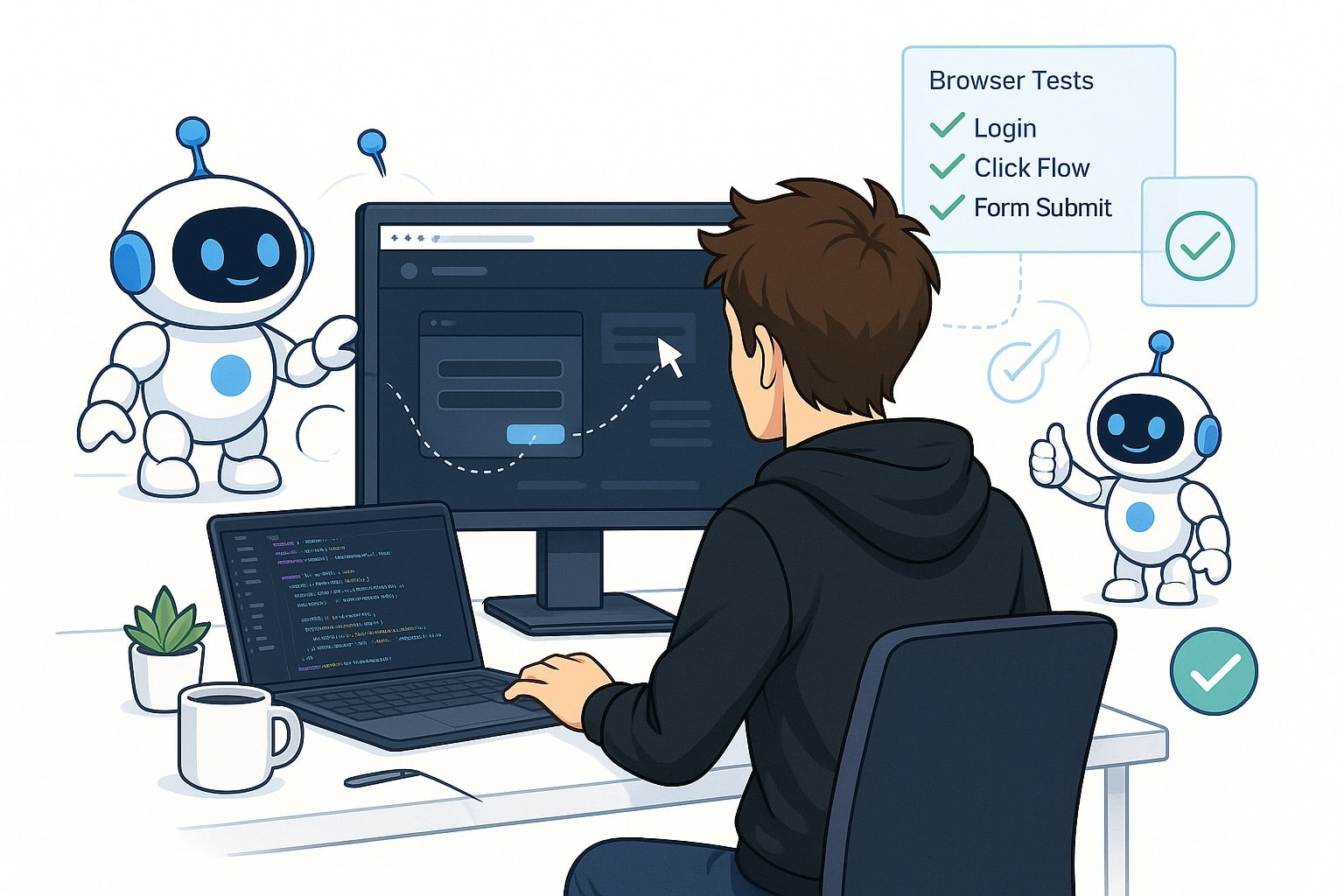
When we integrate automated testing frameworks into the Claude Code workflow, we are essentially giving the agent a "reality check" mechanism. By configuring the agent to automatically execute a suite of E2E tests before finalizing a pull request, companies can achieve:
- Reduced Debugging Latency: Agents can identify and self-correct regression errors before they even reach a human reviewer.
- Continuous Confidence: By maintaining a high coverage of user journeys, the business maintains a constant state of deployability.
- Systemic Integrity: E2E tests validate the interaction between disparate services—APIs, databases, and third-party integrations—ensuring that the agent’s updates respect the holistic architecture.
Scaling ROI through Automated Validation
For the CTO or VP of Engineering, the adoption of agent-driven testing represents a significant shift in resource allocation. In a traditional model, the "cost of quality" is high because it is human-centric. When an agent is empowered to execute E2E tests, the cost of validating a deployment drops precipitously.
Consider the impact on the software development lifecycle (SDLC). If an agent can propose a feature, run a test suite, analyze the failures, and iterate until the tests pass, the human developer moves from being a "coder" to an "architect and auditor." This allows your high-value engineering talent to focus on product strategy and high-level architectural decisions, while the heavy lifting of regression testing and minor patching is offloaded to the AI.
Moreover, the ROI implications extend beyond developer hours. In the context of Digital Transformation, time-to-market is the primary competitive advantage. Companies that utilize AI agents to automate the testing cycle can reduce their sprint cycles by 30% to 50%. This speed is not just about writing code faster; it is about the ability to pivot and iterate based on market feedback without the fear of breaking the production environment.
Strategic Implementation for the Enterprise
To successfully deploy agent-assisted E2E testing, organizations must treat testing code with the same rigor as production code. This requires a shift in how we approach our technical stack. As you look to scale these processes, consider the following strategic pillars:
- Environment Parity: Ensure that the agent has access to environments that mirror production as closely as possible. If the agent is testing in a sandbox that lacks key integration points, the E2E results will be misleading.
- Deterministic Workflows: While AI agents thrive on probabilistic outputs, your testing framework must be deterministic. Focus on clear, binary pass/fail criteria that the agent can interpret without ambiguity.
- Telemetry and Observability: Use your logging and observability platforms to capture not just the result of the test, but the reasoning path the agent took during the failing execution. This creates a feedback loop that improves the agent’s future performance.
Adopting this strategy is not merely a technical upgrade; it is a fundamental shift in corporate culture. It acknowledges that as we automate the creation of software, we must also automate the verification of it. The companies that win in the next decade will be those that view AI agents not as tools that replace developers, but as engines that operate within a robust, self-testing, and self-optimizing ecosystem.
As you look ahead, the challenge will be scaling these agentic workflows across larger, more complex codebases. If you are exploring how to bridge the gap between AI-driven development and reliable production deployments, remember that the foundation of your success lies in the strength of your automation infrastructure. At AOODAX, we specialize in implementing custom AI agents that integrate seamlessly into your existing tech stack, helping your team scale safely and efficiently while maintaining the rigorous standards required for modern enterprise software.