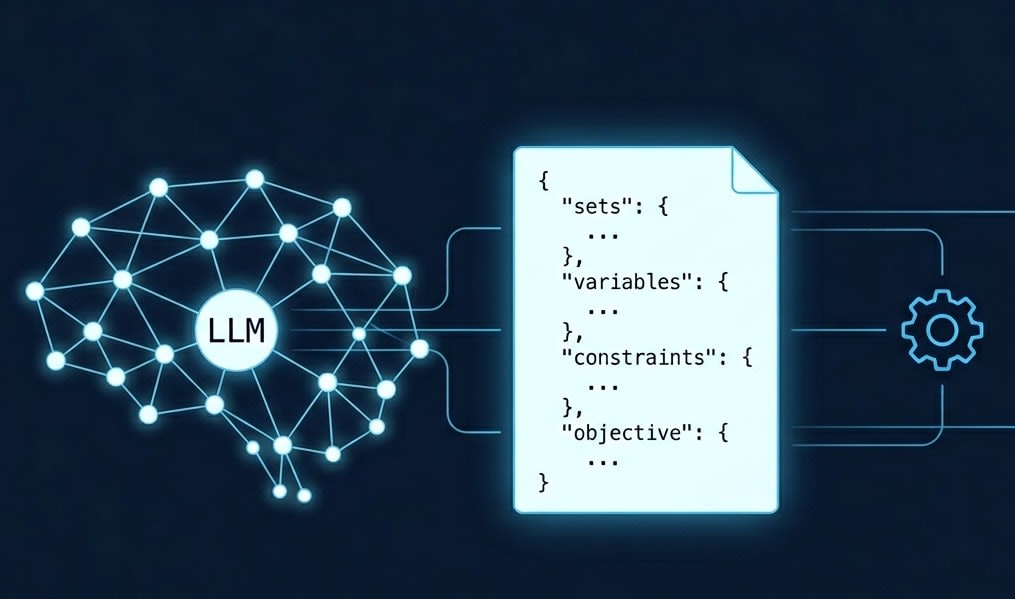
In the race to integrate artificial intelligence into core business operations, many organizations hit a familiar wall: the "black box" syndrome. While model performance is often highlighted, the engineering discipline behind mathematical optimization—the engine room of logistics, supply chain management, and resource allocation—remains dangerously fragmented. For business leaders, the inability to move an optimization model from a laptop-based experiment to a high-availability production environment is a silent killer of ROI.
The solution lies in a structural shift toward Intermediate Representation (IR). By decoupling the high-level optimization logic from the target solver, companies can finally achieve the holy grail of enterprise tech: true portability.
Bridging the Gap Between Logic and Execution
Traditional optimization modeling often locks developers into a specific vendor's solver. If your team writes models in a syntax proprietary to one engine, porting that logic to a more cost-effective or high-performance solver requires a total rewrite. This is where ORPilot and its utilization of IR become a game-changer.
An IR acts as a neutral "language" that sits between the user-defined model and the mathematical solver. It captures the essence of the problem—the variables, the constraints, and the objectives—without tethering them to the hardware or the specific engine version. For an enterprise, the advantages are clear:
- Vendor Agnostic Infrastructure: Avoid being locked into legacy pricing models or restricted by a single vendor’s development roadmap.
- Version Control and Reproducibility: Because the IR provides a static, human-readable snapshot of the model, teams can audit, version, and debug their decision-making logic as easily as they manage traditional source code.
- Rapid Iteration Cycles: Developers can test multiple solvers against the same IR to determine which offers the best efficiency for specific operational scales, significantly reducing the "time-to-solve" bottleneck.
Operationalizing Optimization for AI Agents
As we move toward a future defined by AI agents—autonomous systems capable of making complex, real-time decisions—the importance of portable optimization becomes even more pronounced. These agents are not just processing data; they are executing continuous optimization loops to manage inventory, customer churn, or dynamic pricing within a CRM.
If the underlying optimization logic is fragile or locked to a specific environment, the agent becomes brittle. Integrating IR-based architecture ensures that these autonomous systems remain robust as they scale across cloud environments or shift between localized and edge computing nodes. Companies that adopt this architectural rigor today will find it significantly easier to upgrade their automated decision-making pipelines tomorrow.
Looking Ahead: The ROI of Portability
The shift toward IR-backed optimization is not just a technical preference; it is a strategic necessity for digital transformation. By treating optimization models as portable assets rather than bespoke scripts, businesses mitigate the risk of technical debt and ensure long-term stability. As AI matures, the competitive advantage will go to firms that can swap components, optimize costs in real-time, and maintain absolute reproducibility in their automated decisions.
At AOODAX (aoodax.com), we help organizations bridge this gap by building custom AI agents that turn complex optimization challenges into seamless, automated workflows. Whether you are scaling internal logistics or refining client-facing automated strategies, our team provides the architecture necessary to keep your business agile and data-driven.