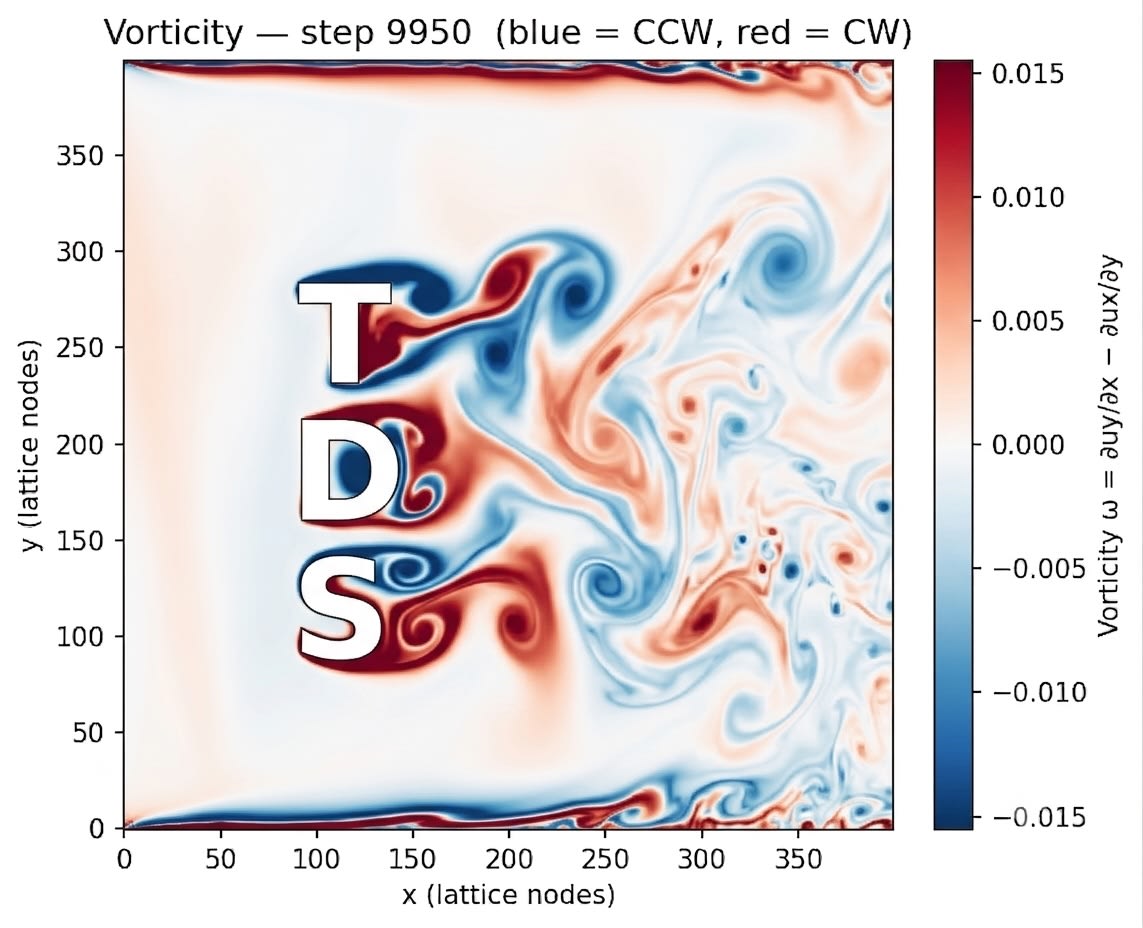
For decades, the standard approach to computational fluid dynamics (CFD) has relied on the brute-force integration of the Navier-Stokes equations. If you wanted to simulate how air moves over a wing or how water flows through a turbine, you had to solve complex partial differential equations that track pressure, velocity, and density across a mesh. It was computationally expensive, notoriously difficult to scale, and often led to "bottlenecking" where the simulation’s complexity outpaced the hardware's capacity.
However, a paradigm shift is occurring. We are seeing a move away from deterministic, equation-based solvers toward approaches rooted in statistical mechanics—most notably, the Lattice Boltzmann Method (LBM). By stepping away from the "top-down" approach of solving macroscopic equations and instead modeling the "bottom-up" interactions of virtual particles, engineers are achieving results that were previously considered impossible to compute in real-time.
The Statistical Leap: Beyond Deterministic Solvers
The brilliance of LBM lies in its departure from classical physics modeling. Instead of calculating the global behavior of a fluid, LBM simulates the simplified movement of particle "packets" on a lattice. These particles stream to neighboring nodes and collide, effectively mimicking the microscopic interactions that, when aggregated, perfectly reconstruct the complex macroscopic patterns of fluid flow—such as the famous Kármán vortex street, a repeating pattern of swirling vortices.
For business leaders, the takeaway is not the physics; it is the computational efficiency. Because LBM relies on local, grid-based interactions, it is inherently parallelizable. While traditional solvers struggle to scale across massive GPU clusters due to their global dependency requirements, LBM thrives in high-performance computing (HPC) environments.
This shift has profound implications for digital transformation, specifically in how companies approach R&D and product design:
- Drastic Reduction in Time-to-Market: By moving from hours-long batch simulations to near-interactive feedback loops, design teams can iterate through hundreds of prototypes in the time it used to take for one.
- Cost-Efficiency at Scale: Because these models are computationally "lighter" than traditional Navier-Stokes solvers, the cloud infrastructure costs required to run them drop significantly, providing a clearer ROI on R&D budgets.
- High-Fidelity Virtual Prototyping: Businesses can now simulate complex environments—like urban airflow for climate-resilient architecture or blood flow for medical device design—with a level of granularity that was previously restricted to university research labs.
From Physics Engines to Intelligent Automation
The implications of this move toward simplified, high-efficiency modeling extend well beyond pure engineering. As we see this transition in physics simulations, we are witnessing a similar trend in the broader enterprise AI landscape. Just as LBM achieves complex results by focusing on local, distributed interactions rather than monolithic equations, modern AI Agents are moving away from rigid, rule-based automation toward decentralized, event-driven architectures.
In the context of Digital Transformation, this is the "LBM approach" applied to business processes. Rather than trying to build a single, monolithic AI model that solves every customer query or operational bottleneck—an approach that mirrors the struggle of traditional fluid equations—forward-thinking organizations are deploying specialized, lightweight agents that handle localized, specific tasks. When these agents collaborate, they produce a systemic "flow" of efficiency that is far more robust and scalable than any single, centralized system.
Consider how this applies to CRM systems. Legacy CRM platforms were often bloated, rigid data silos. Modern, AI-driven architectures are moving toward fluid, modular ecosystems where individual data agents handle specific interactions—lead scoring, sentiment analysis, or automated scheduling—interacting in real-time to create a seamless customer experience. By replacing "hard-coded" logic with these fluid, adaptive processes, businesses can pivot as quickly as the market changes, avoiding the technical debt that often plagues large-scale digital implementations.
The Strategic Path Forward
As the computational landscape becomes more commoditized and powerful, the competitive advantage will not belong to the companies that have the biggest "supercomputers," but to those who can model their operations with the most fluidity. We are entering an era where the ability to simulate and automate at the "particle level"—whether that means physical fluid dynamics or granular business process automation—is the new baseline for market leadership.
For leaders, the mandate is clear: Stop looking for the "master equation" to solve your operational complexities. Instead, invest in modular, scalable frameworks that allow your systems to adapt, collide, and evolve in response to real-time data inputs. The future of enterprise intelligence is not about finding a single solution to a complex problem; it is about building the environment where the right outcomes emerge organically.
As organizations move toward these more responsive, intelligent infrastructures, the integration of custom-tailored systems becomes essential. At AOODAX, we assist businesses in navigating this transition by developing specialized custom software solutions designed to bridge the gap between complex operational requirements and the agility required to scale in a competitive digital landscape.