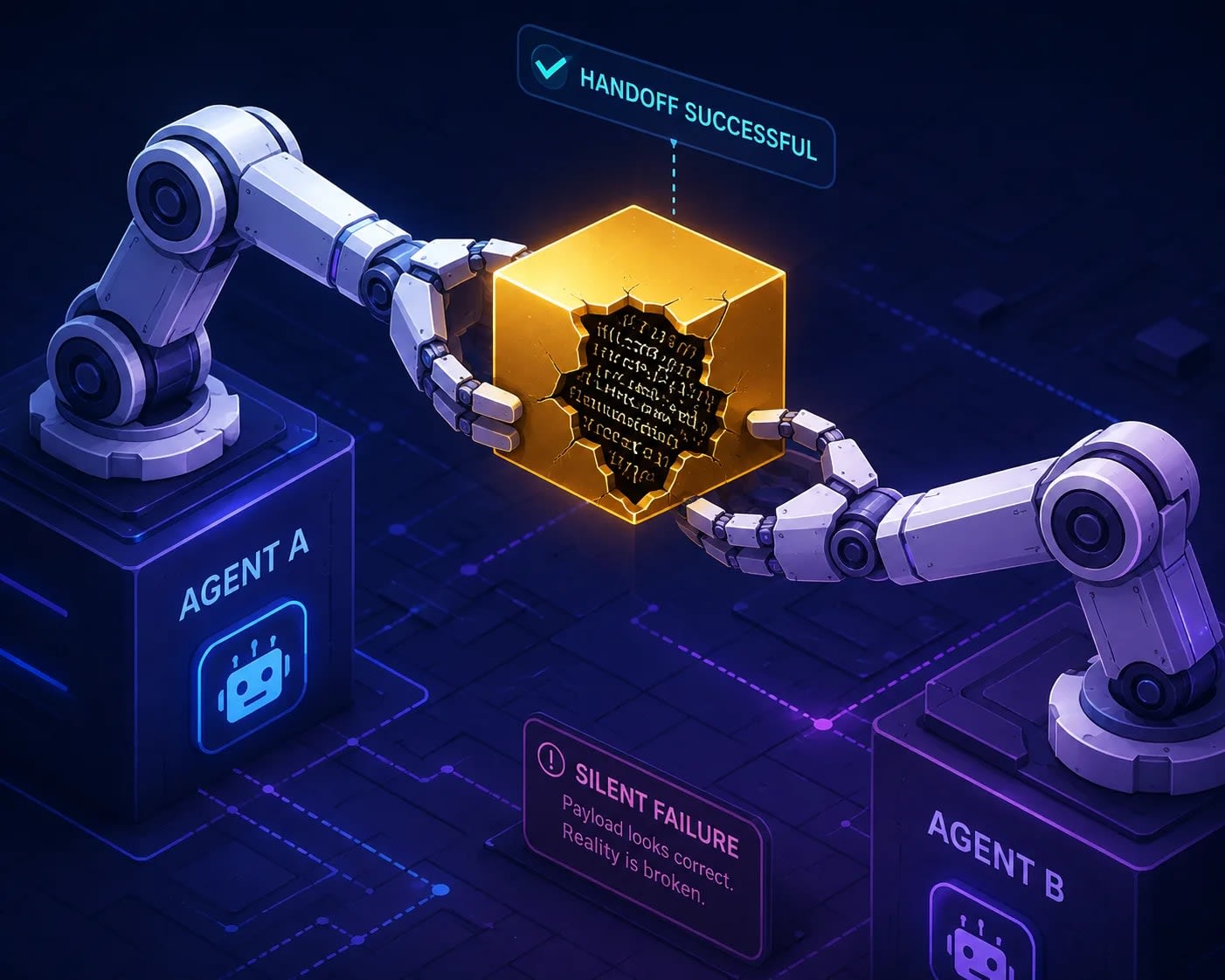
In the race to automate complex workflows, the industry has shifted its focus from simple chatbots to sophisticated Multi-Agent Systems (MAS). These architectures, where specialized agents collaborate to solve intricate problems, promise a level of operational efficiency previously reserved for large human teams. However, as these systems move from pilot programs to production environments, a silent crisis is emerging.
We are seeing a trend where MAS deployments pass rigorous unit testing and automated evaluations with flying colors, only to collapse under the weight of real-world ambiguity. This disconnect—where the "test" score says success, but the "business" outcome says failure—is the defining challenge of the current AI-maturity cycle.
The Illusion of Correctness: Why Evaluation Isn’t Enough
The disconnect between evaluation metrics and production reliability often stems from how we define "success" in AI development. Most engineering teams rely on static datasets and benchmarks to measure agentic performance. They verify that the agent generates the correct JSON structure, that it calls the right API, or that the final response contains a specific keyword.
But a payload can be structurally correct while being logically disastrous. In a multi-agent framework, agents are interdependent. If Agent A generates a result that is technically valid but grounded in a stale understanding of a client's Customer Relationship Management (CRM) database, Agent B will process that "correct" data and propagate an error down the chain. By the time the system reaches the final output, the cumulative drift renders the entire operation useless.
Business leaders must recognize that evaluating a system by its individual parts is a recipe for failure. An agent system is a living organism, not a fixed script. When evaluation happens in a silo, it ignores the "state drift" that occurs when an agent interacts with the live, shifting context of your enterprise.
- Metric Myopia: Relying solely on LLM-as-a-judge benchmarks that measure token accuracy rather than business logic.
- Temporal Decay: Failing to account for how real-time data inputs differ from the static data used during the development phase.
- The Hallucination Cascade: When early-stage agent errors compound as they move through a multi-agent pipeline, creating a "correct-looking" error that masks the root cause.
Implementing the Watchdog Pattern for Resilient Automation
To bridge the gap between "passing tests" and "reliable outcomes," forward-thinking engineering teams are adopting the Watchdog Pattern. Unlike a traditional validator that checks the output once, a watchdog acts as an autonomous overseer that operates alongside the agent swarm. It exists outside the primary execution loop, continuously monitoring the logic, context, and potential side effects of agent interactions.
By decoupling the "execution logic" from the "governance logic," you allow your agents to remain creative and agile while ensuring the watchdog keeps them tethered to the company's business rules.
Here is how businesses can architect this resilience into their AI pipelines:
- State-Aware Validation: The watchdog must have read access to the system’s current state. It compares agent outputs against the most recent data snapshots rather than just checking if the formatting is correct.
- The "Circuit Breaker" Trigger: If the watchdog detects a divergence from the expected business outcome—even if the agent’s output is technically valid—it triggers a circuit breaker. This halts the agent workflow before the bad data is committed to your CRM or internal systems.
- Human-in-the-Loop Escalation: When the watchdog intercepts a suspicious payload, it shouldn't just kill the process. It should bundle the context, the agent’s rationale, and the detected inconsistency into a concise report for human review. This transforms the failure into a learning opportunity for fine-tuning the agents.
- Logging for Explainability: A robust watchdog acts as an immutable audit trail. This is not just for debugging; it’s for compliance and ROI analysis. Being able to demonstrate why an agentic process was halted is a key component of enterprise-grade Digital Transformation.
The Strategic ROI of Defensive AI
From a C-suite perspective, the goal is not just to build agents, but to build trust in automation. If an agentic system breaks once, the organization loses confidence. If it breaks silently—producing technically correct but business-critical errors—it can cause significant financial and reputational damage.
The investment in governance, observability, and the watchdog pattern is often viewed as "extra engineering cost." In reality, it is a risk mitigation strategy. Companies that integrate these safeguards early in their deployment cycle are seeing significantly higher Return on Investment (ROI) because they spend less time on "patchwork" fixes and incident response.
As we look toward the next twelve months, the competitive advantage will go to organizations that treat AI reliability as a core feature of their software architecture. We are moving away from the "move fast and break things" era of generative AI and into an era of "move purposefully and verify everything." For business leaders, this means demanding higher standards of observability from your AI vendors and internal teams. The question should never be "did the agent output a response?" but rather "did the watchdog verify that this output meets our current business criteria?"
Building a reliable multi-agent system requires more than just smart prompt engineering; it requires a structural commitment to oversight and validation. At AOODAX, we specialize in designing robust AI agents and automated workflows that are built with governance and verification at their core, ensuring your business realizes the promise of automation without the risk of silent failure.