In the landscape of modern enterprise data, the "single source of truth" is often more of an aspiration than a reality. For many organizations, the dirty secret of digital transformation is that their mission-critical databases are riddled with ghosts. Whether it is a supplier listed as "Global Tech Solutions," "Global Tech Inc.," "GTS," or "Global Tech Sols," these variations are not just annoying—they are structural barriers to operational efficiency.
The industry has spent years chasing the dream of "fuzzy matching" as the silver bullet for this problem. We rely on algorithms that generate similarity scores, hoping that a 91% match threshold will correctly consolidate our records. However, as any data engineer who has spent a weekend manually fixing failed merges will tell you, a 91% score is often a trap. It is a probabilistic guess that frequently masks a deterministic reality. As we shift toward an era of AI Agents and autonomous business processes, our tolerance for "close enough" matching is reaching a breaking point.
The Fallacy of Probabilistic Deduplication
When we talk about data deduplication at scale, the conventional approach involves Levenshtein Distance or Jaccard Similarity. These metrics quantify how many edits are needed to turn one string into another. They are elegant in theory, but brittle in production.
The core issue is that similarity scores lack context. A similarity score of 91 might correctly link two versions of a company name, but it might also accidentally merge two completely distinct subsidiaries simply because their names share common keywords. When you scale this across 10,000 or 100,000 records, the margin for error grows exponentially.
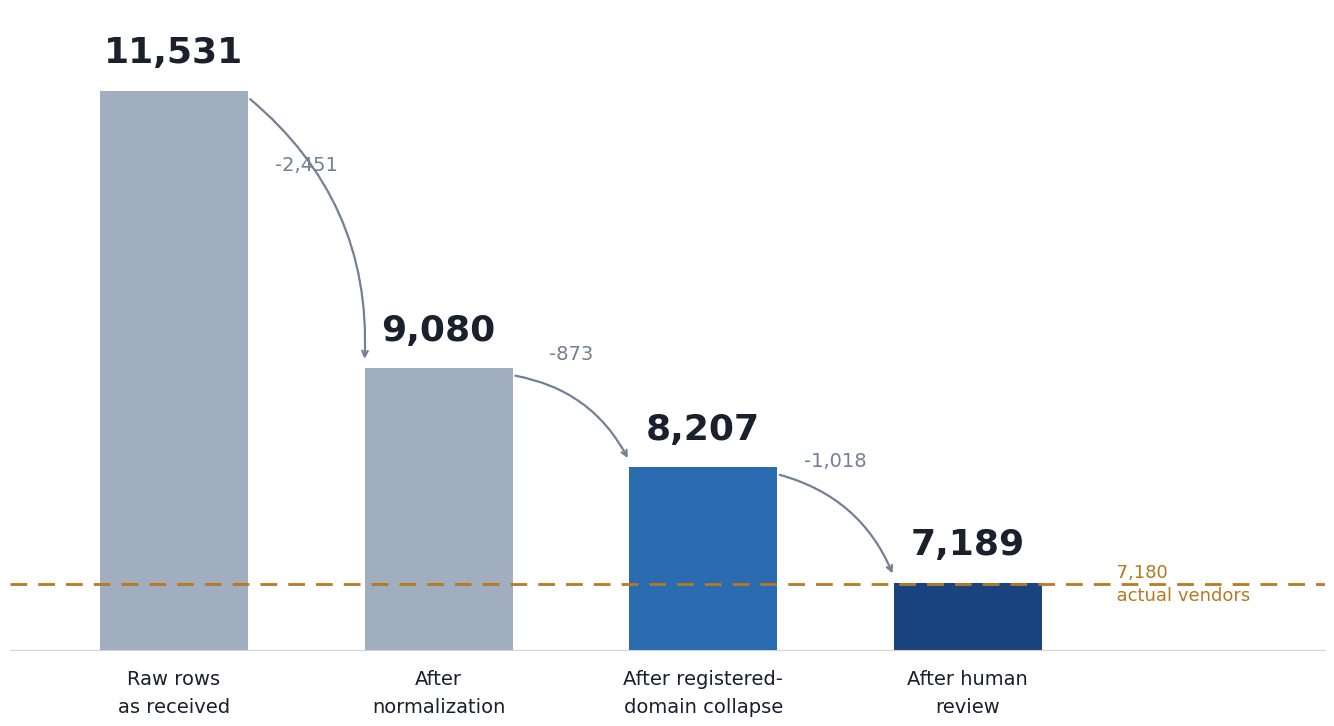
This is where the industry is seeing a paradigm shift: moving away from a "score-everything" mentality toward Deterministic Staging. Instead of asking an algorithm to "guess" if two records are the same, we apply a series of rule-based filters that strip away the noise before any similarity scoring occurs. By implementing a layered pipeline, organizations can enforce strict normalization rules—such as standardizing legal entity suffixes (e.g., changing "LLC," "Ltd," and "Corp" to a uniform format) or mapping known abbreviations to their canonical forms—before the heavy-duty probabilistic logic ever touches the data.
Why Deterministic Pipelines Drive ROI
For business leaders, the cost of data duplication isn't just storage. It is the friction that ripples through the entire CRM (Customer Relationship Management) ecosystem and supply chain. When an AI agent is tasked with reconciling invoices or predicting procurement needs, it needs high-fidelity data. If the system perceives four spellings of a vendor as four separate entities, the downstream impact is profound:
- Fragmented Spend Analysis: You cannot negotiate volume discounts if your system believes your spend is distributed across ten vendors instead of one.
- Customer Experience Gaps: A client receiving redundant marketing communication or disparate account updates perceives the company as fragmented and incompetent.
- Failed Automation Loops: If your Automation workflows are triggered by record updates, dirty data will cause your bots to misfire or stall, requiring expensive human intervention to correct the exception logs.
Adopting a deterministic approach to data cleaning doesn't mean abandoning advanced AI; it means enabling it. By preprocessing data through deterministic stages, you remove the "garbage" that forces your machine learning models to hallucinate or underperform. This transition is not just a technical preference; it is a prerequisite for achieving a high return on investment (ROI) from digital transformation initiatives.
Future-Proofing Through Architectural Rigor
As companies integrate more sophisticated Custom Software solutions to manage their internal workflows, the design of these pipelines becomes a competitive advantage. The trend is moving toward "human-in-the-loop" deterministic staging. In this model, the software identifies high-certainty matches through deterministic rules, while flagging ambiguous cases for human review or advanced Large Language Model (LLM) verification.
This approach allows companies to build "Self-Healing Data Layers." Instead of relying on a one-off project to clean the CRM, businesses are building real-time ingestion pipelines that treat deduplication as a continuous process. By enforcing strict schemas and normalization rules at the point of entry—or at the integration layer between legacy systems—you prevent the "data drift" that historically plagues enterprise software.
For leadership, the takeaway is clear: do not treat deduplication as a math problem to be solved by a single algorithm. Treat it as a process-architecture challenge. Invest in the "pre-game"—the standardization, the cleaning, and the deterministic filtering—and you will find that the actual matching task becomes exponentially easier, faster, and more accurate.
As we look toward an increasingly automated future, the quality of your data will determine the intelligence of your systems. At AOODAX, we specialize in designing robust data architecture and custom software integration that ensures your business processes run on clean, reliable foundations, allowing your team to focus on growth rather than data reconciliation.