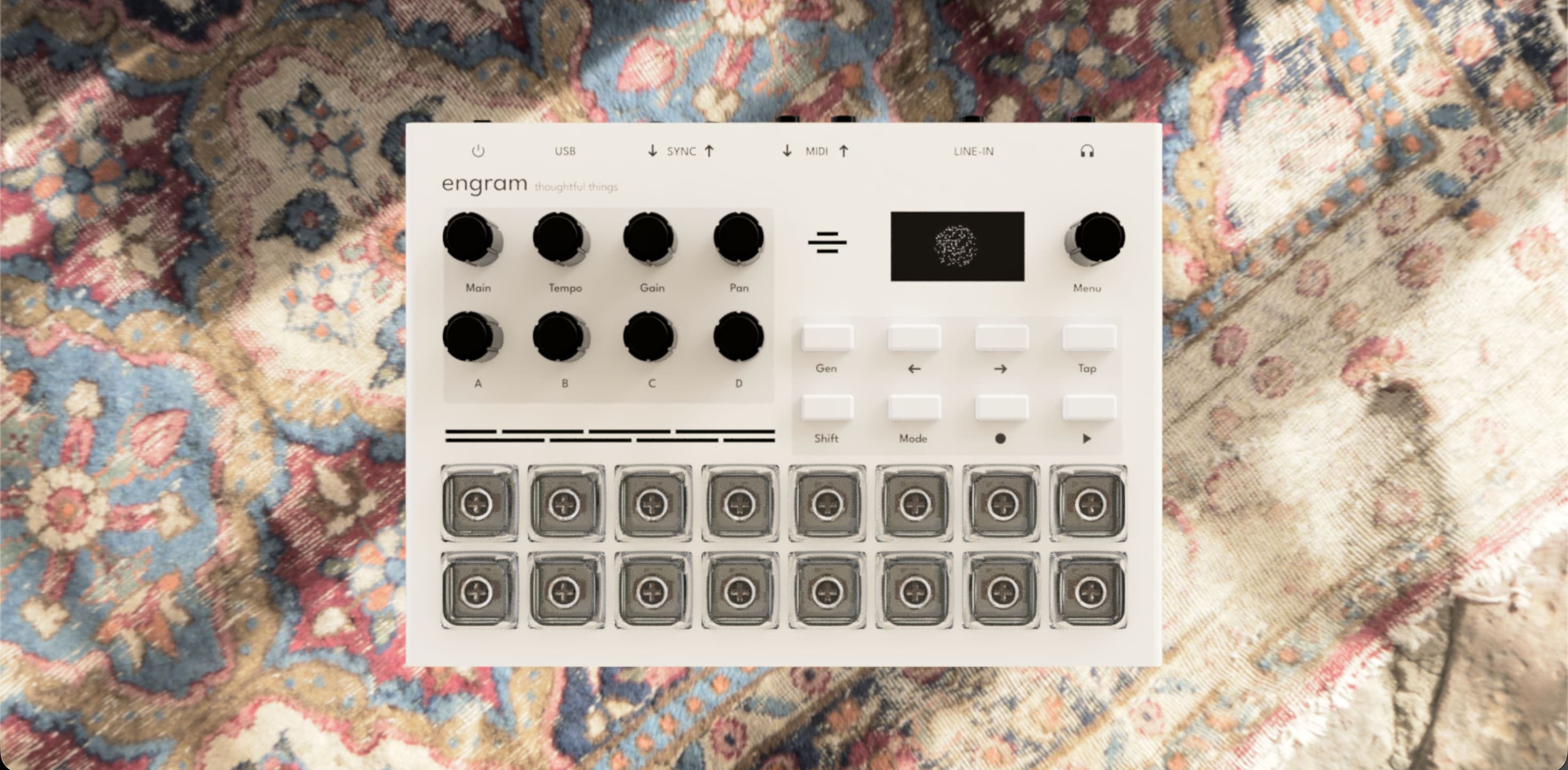
The narrative surrounding artificial intelligence in the creative sector has been dominated by a singular, somewhat exhausted archetype: the "text-to-result" generator. Whether it is a chatbot drafting an email or a web-based music service churning out radio-ready pop songs based on a three-word prompt, the industry standard has prioritized polish, speed, and seamless output. However, a new device, Engram, developed by the startup Thoughtful Things, represents a sharp, refreshing pivot away from this polished perfectionism. By positioning AI as a tool for "controlled chaos" rather than mindless automation, Engram challenges our assumptions about how machine learning should integrate into the creative workflow.
At its core, Engram is a hardware sampler and groovebox that leverages a proprietary, locally run AI model to manipulate audio input. Unlike cloud-based music generators that aim to deliver a finished product, Engram embraces the "hallucination"—the tendency of AI models to misinterpret data and generate unexpected, often uncanny results. By running a custom "tiny AI" model directly on the hardware without an internet connection, Thoughtful Things has stripped away the friction of cloud latency and privacy concerns, opting instead for a tactile, experimental interface that treats AI as a collaborator rather than a replacement.
The Business Case for Embracing Imperfection
For business leaders and technology strategists, Engram serves as a potent metaphor for the next stage of digital transformation. For years, the enterprise focus has been on achieving deterministic outcomes: "If I put data in, I must get a perfectly predictable, accurate report out." This obsession with 100% accuracy has led to a stagnation in how we use AI for innovation. While accuracy is non-negotiable in accounting or logistics, the creative and strategic departments of modern companies are suffering from a "vanilla" effect—an over-reliance on generative models that regress toward the mean.
The lessons from Engram suggest that the highest ROI in the coming years will not come from more automation, but from "augmented serendipity." By allowing AI to distort, reinterpret, and occasionally "hallucinate" within a controlled framework, businesses can unlock creative bottlenecks that traditional, rigid software cannot touch.
Consider the implications for digital transformation in the following areas:
- Ideation and Prototyping: Just as Engram uses AI to mangle audio, enterprise design teams can use AI models tuned to find anomalies, testing the durability of product concepts by forcing the software to generate "broken" or unexpected iterations.
- Customer Experience (CX) Differentiation: Companies that rely solely on standard, predictable AI chatbots often find their brand voice becoming indistinguishable from competitors. By integrating models that embrace a more distinctive, "uncanny" creative flair—managed under strict brand guidelines—businesses can develop more memorable digital touchpoints.
- Edge Intelligence: Engram’s decision to keep its model local is a preview of the "Local AI" movement. Businesses concerned with data sovereignty and latency are increasingly moving away from massive cloud-dependent LLMs toward compact, specialized models that run on-premise or at the edge.
Beyond the Prompt: A New Paradigm for AI Integration
The rise of the AI Agent—autonomous systems capable of completing complex tasks—is the natural evolution of this trend. While many equate AI agents with task-based automation, the true potential lies in their ability to handle ambiguous, non-linear workflows. Engram represents the hardware manifestation of this: it does not just execute a command; it participates in an iterative process.
For the business professional, the takeaway is clear: stop looking for AI that simply does the work for you. Start looking for AI that expands the scope of what is possible within your existing infrastructure. This requires a shift in mindset from "AI as a tool for efficiency" to "AI as a partner for exploration."
Adopting this mindset has tangible benefits:
- Risk Reduction: By utilizing smaller, custom-trained local models rather than massive, black-box third-party models, firms retain greater control over their intellectual property and data security.
- Increased Intellectual Agility: Teams that learn to guide AI through the "hallucination" phase—filtering the noise to find the signal—develop a deeper understanding of the underlying data, making them more resilient to market disruptions.
- Enhanced Brand Identity: In a sea of AI-generated content that feels sterile and repetitive, leaning into "imperfect" or unconventional outputs can help firms stand out as innovators rather than mere automated copycats.
As we look toward 2025 and beyond, the most successful organizations will be those that balance their need for rigid, high-performance automation with a healthy appetite for the experimental. The goal is to build an architecture where your systems are robust enough to handle the mundane, yet fluid enough to support the radical experimentation that drives long-term competitive advantage.
Ultimately, whether you are managing audio samples or enterprise-level data streams, the principle remains the same: the machine should handle the heavy lifting, but the human must remain the curator of the unpredictable. At AOODAX, we help business leaders navigate this balance by architecting custom AI agents and automation workflows that align perfectly with your internal innovation cycles, ensuring your digital evolution is as creative as it is efficient.