The democratization of robotics research has reached a significant inflection point. For years, the barrier to entry for training vision-language-action (VLA) models was astronomical, restricted to labs with massive GPU clusters and dedicated machine learning engineering teams. However, the emergence of lightweight, accessible fine-tuning methodologies—specifically those utilizing Low-Rank Adaptation (LoRA)—has fundamentally changed the landscape. Business leaders who once viewed embodied AI as a "science experiment" now have a roadmap for integrating custom robotic intelligence into their operational workflows using nothing more than cloud-based notebook environments.
Fine-tuning a robot AI model on a platform like Google Colab is no longer just a hobbyist’s project; it is a proof-of-concept for how enterprises can adapt foundational robotic intelligence to their unique manufacturing, logistics, or service environments without starting from scratch.
From Foundation Models to Functional Automation
The shift toward OpenVLA and similar open-source frameworks represents a move toward modular intelligence. Unlike traditional industrial robots that follow rigid, pre-programmed paths, these models interpret visual input and translate it into actionable movement. By applying LoRA, developers can "freeze" the core intelligence of a large pre-trained model and only train a small fraction of the parameters. This is the "aha!" moment for many CTOs: you don’t need millions of dollars in compute to refine a robot's ability to pick, place, or manipulate objects in your specific facility.
When we consider the transition toward AI Agents within the physical world, the ability to iterate quickly becomes a competitive advantage. The workflow typically involves:
- Dataset Sanitization: Ensuring the visual-action data corresponds precisely to the specific physical task.
- Hyperparameter Optimization: Balancing learning rates and rank settings to prevent catastrophic forgetting of the model’s pre-learned general capabilities.
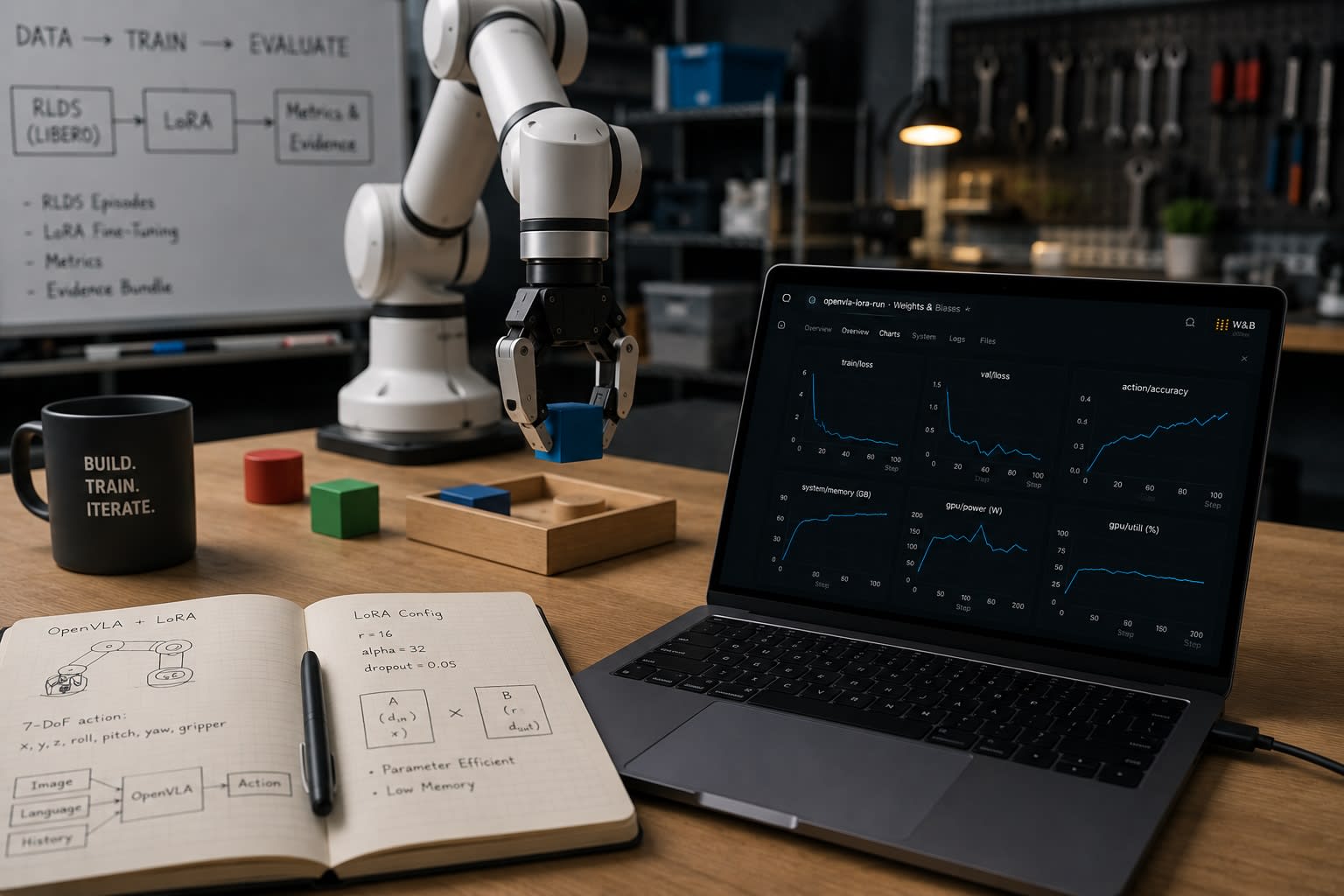
- Validation through Monitoring: Integrating tools like Weights & Biases (W&B) to track loss curves and physical success rates in real-time.
For businesses, this translates to shorter R&D cycles. If your logistics team needs a bot to handle a new packaging shape or navigate an evolving warehouse layout, you no longer need to retrain the entire neural architecture. You can fine-tune the existing agent to adapt to the new environment in a fraction of the time.
ROI and the Future of Embodied Digital Transformation
The return on investment (ROI) for custom robotic AI is becoming increasingly clear. By lowering the cost of experimentation, companies can move away from "all-or-nothing" automation investments toward an iterative deployment model. This aligns perfectly with modern Digital Transformation strategies, where agility is prioritized over monolithic infrastructure.
The impact of this technology on the bottom line is twofold:
- Reduction in Operational Latency: By training models on edge-case scenarios specific to your supply chain, you minimize the downtime associated with "error states" that traditional automation struggles to resolve.
- Infrastructure Efficiency: Utilizing cloud-native environments for training means that enterprises can scale their R&D efforts vertically without needing to invest in heavy physical server hardware until they are ready for mass deployment.
However, the leap from a successful Colab notebook run to a production-grade fleet of autonomous agents is not trivial. It requires a robust pipeline for data governance, consistent monitoring, and the integration of these robotic models with existing enterprise software, such as Customer Relationship Management (CRM) systems or internal ERP platforms. When a robot completes a task, the feedback loop—updating inventory levels or logging a service completion—must be automated to ensure that the physical work informs the digital reality of the business.
Navigating the Frontier of Robot-Human Collaboration
As we look toward the next three to five years, the adoption of fine-tuned VLA models will likely migrate from the R&D lab to the warehouse floor. We are moving toward a paradigm where AI agents function as universal adapters between digital directives and physical labor. The leaders who succeed will be those who establish a "data flywheel"—a process where every successful movement or correction made by a robot is logged, analyzed, and fed back into the next iteration of the model’s fine-tuning.
For the business leader, the takeaway is simple: the intelligence you need is already out there, hidden within massive open-source models. The hurdle isn't the code; it’s the strategy of identifying which niche tasks in your enterprise are ripe for robotic automation and creating the data environment necessary to train those models. By focusing on modular, fine-tunable frameworks, companies can avoid the trap of vendor lock-in and retain ownership of their proprietary operational expertise.
The technology is ready, the barriers are dropping, and the compute is accessible. The only remaining question is how effectively your organization can curate the data that makes these robots uniquely yours. At AOODAX, we help businesses bridge this gap by architecting intelligent AI agents and automation systems that translate sophisticated machine learning models into tangible, automated workflows, ensuring that your transition to an AI-driven future is as seamless as it is impactful.