In the high-stakes world of enterprise data analytics, the "perfect" model is a myth. Executives often rely on dashboard insights to guide multi-million dollar investments, but those insights are frequently anchored in legacy statistical methods that crumble under the weight of real-world noise. For years, Linear Regression has served as the bedrock of predictive modeling. Yet, in modern business environments—where data pipelines are messy, erratic, and often corrupted by black-swan events—standard Ordinary Least Squares (OLS) regression acts like a fragile glass vase in a hurricane.
To survive the turbulence of enterprise data, leaders must transition from classical estimation techniques toward Robust Estimation, a methodology that ensures your AI-driven decisions remain anchored in reality rather than skewed by the anomalies lurking in your datasets.
The Fragility of Classical Models in Modern Data Environments
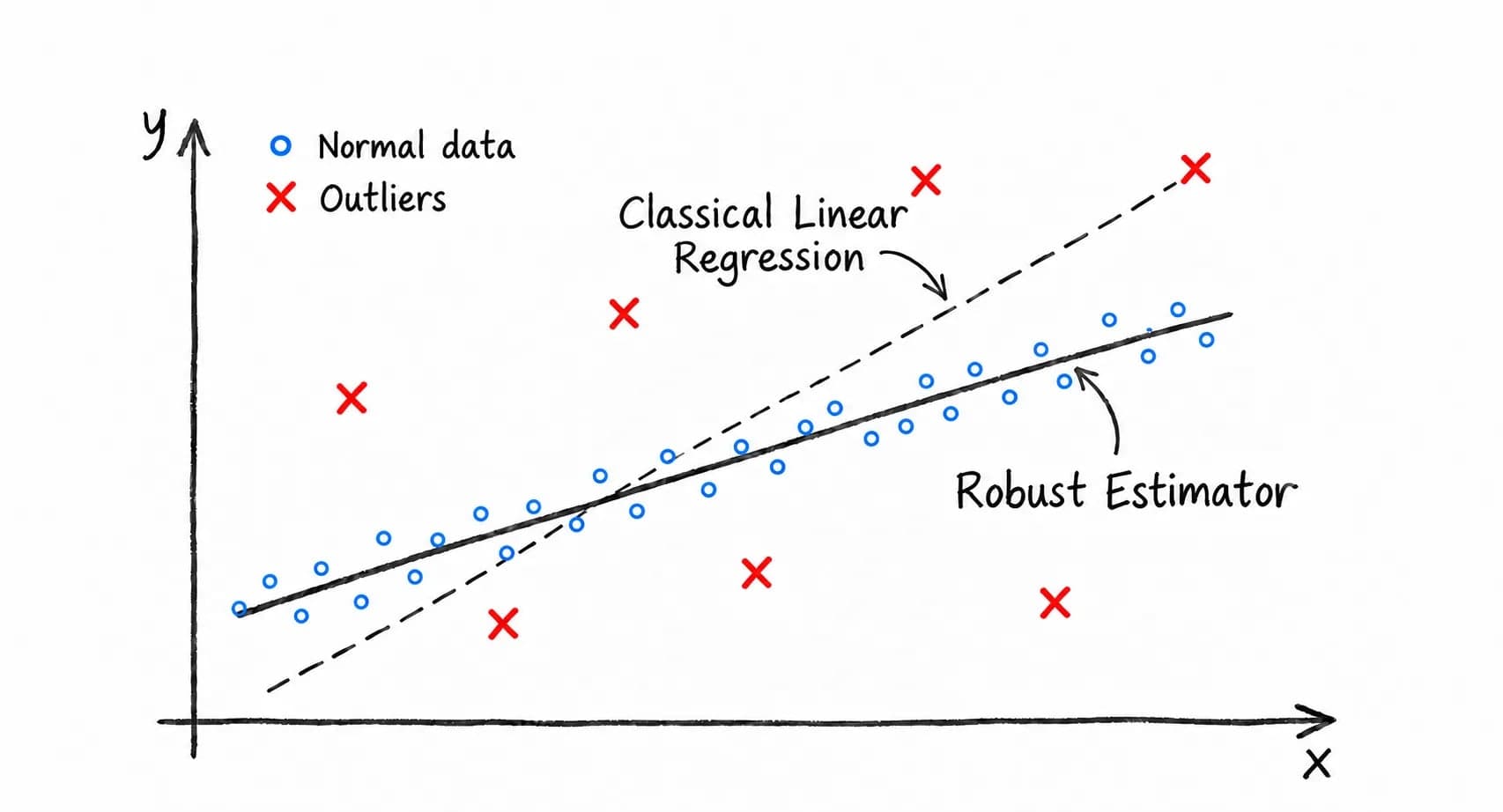
At the heart of many automated forecasting tools is the linear regression model. Its simplicity is its greatest strength, but its sensitivity to outliers is its primary weakness. In a traditional OLS model, the algorithm attempts to minimize the sum of the squared residuals. Mathematically, this means that even a single extreme data point—a fraudulent transaction, a temporary supply chain outage, or a server log spike—can exert a disproportionate "leverage" on the entire line of best fit.
For a business, this creates a dangerous feedback loop. If your CRM is feeding skewed historical data into your predictive sales engine, the resulting model will misallocate resources. You end up with a strategy built on a tilted foundation. When we look at Digital Transformation initiatives across the Fortune 500, we see that the failure of these projects often isn’t due to bad algorithms, but rather "bad data sensitivity."
Robust estimation techniques offer a solution by limiting the influence of these outliers. Instead of allowing extreme values to dictate the direction of the regression line, modern robust estimators—such as M-estimators, Theil-Sen estimators, or RANSAC (Random Sample Consensus)—down-weight or effectively ignore data points that fall outside the expected distribution. This ensures that your business intelligence remains reflective of the "typical" user behavior or market trend, rather than being hijacked by a statistical anomaly.
Integrating Robustness into AI Agents and Automation
As we move toward a paradigm of AI Agents that autonomously manage tasks like inventory replenishment, lead scoring, and customer sentiment analysis, the cost of a "brittle" model rises exponentially. An autonomous agent that relies on standard regression might trigger a massive, erroneous purchasing order because it failed to account for a momentary, anomalous spike in web traffic.
To build resilient, automated systems, organizations must adopt a tiered strategy for data ingestion and modeling:
- Audit for Leverage: Before training an AI model, perform high-leverage point analysis. Identify data clusters that deviate significantly from historical norms to determine if they represent actionable intelligence or mere noise.
- Implement Robust Loss Functions: Transition your engineering teams from standard Mean Squared Error (MSE) loss to robust loss functions like the Huber Loss or Log-Cosh Loss. These functions behave linearly for large errors, preventing outliers from dominating the gradient updates during training.
- Hybrid Validation Pipelines: Deploy cross-validation methods that include synthetic "noise injection." By testing how your models perform when exposed to corrupted data, you can build confidence in their stability before deploying them into live production environments.
The ROI implications here are significant. By reducing the frequency of model retraining caused by outlier sensitivity, companies decrease their technical debt and lower the operational overhead of constant manual intervention. Furthermore, stable models provide more consistent outputs, which translates to a more reliable Customer Relationship Management (CRM) experience. When your marketing AI accurately predicts customer churn—undeterred by a single, unrepresentative month of data—the long-term impact on customer lifetime value (CLV) is immediate and measurable.
The Future of Resilient Analytics
The shift toward robust estimation is not merely a technical upgrade; it is a fundamental requirement for the maturation of enterprise AI. As organizations move away from simple reporting and toward fully automated, decision-making agents, the ability of a system to "self-correct" its perception of reality becomes a competitive advantage.
Business leaders should look for development partners who prioritize statistical integrity as highly as code quality. The goal is to build systems that recognize when the data is trying to lie to them. In an age of massive datasets, the "smartest" model is not the one that fits every data point perfectly—it is the one that knows which data points to ignore. By embedding robust logic into your predictive infrastructure, you protect your company from the cascading errors that turn smart AI into a liability.
Ultimately, success in the current data-driven era depends on building software that can distinguish between a new trend and a simple glitch. At AOODAX, we help businesses build resilient digital foundations by integrating advanced, robust AI agents directly into your existing workflows, ensuring your automated processes remain accurate even when your data is anything but.